From Father to Nothing · chapter ten
And So It Begins, Again
Previously: The Checklist
My father died on a Friday. An embolism. A few minutes. Nobody planned it, he least of all.
Afterwards I sat in his chair in his office. On the back, a sticker with his name. I looked around. The artefacts he had collected. Unanswered post. A mess in the drawer. Smaller one than mine. What I mostly remember is the drawer.
Back then I thought that all of it would end in nothing. The companies, my father, me. From Father to Nothing.
We have no idea what is coming. My father did not know it was his last Friday. I did not know I would be dealing with people I had not chosen.
The probability that you hand the same business on through three generations is small. Through five, negligible. Most businesses do not prosper, and the ones that do have to change in order to survive. And a change is a new business under an old name. Another coin toss.
So I am not building a fortress. A fortress stands until someone decides to take it. Or it loses its meaning with time, like all the castles that end up as tourist attractions. I would rather have an organism. Something that can adapt, shed a part, grow back elsewhere. A garden, not walls.
And the soil we all return to is not nothing. It is everything things grow from.
In a garden you do not hand on the plants. You need people who can tell what has withered and are not afraid to pull it out. Who know they can look after themselves even if they lost everything standing there.
What can be handed on is not the firm. A firm is one chapter, and one day it closes. What can be handed on is enterprise. The ability to be useful and to ask for money for it. The appetite to try. And the certainty that when something fails, there is somewhere to come back to, and nobody will be loved any less for it.
That is also where what I leave my daughter comes from. Not a firm. A safety net, so that she can try things, make mistakes and have somewhere to come back to. Do not be a slave to wealth. Use it. And leave freedom to those who come after you. Not the freedom to have whatever you want. That craving has no bottom. The opposite. The freedom not to do stupid work. The freedom not to have a stupid boss. The freedom not to do what makes no sense.
If she goes into business, it does not matter what kind. It can be a job that has nothing to do with our family. Not in the same country. For all I know, not on the same planet.
We are mortal. And we are afraid that after life there is nothing. That is exactly what drives us forward. If we had the time, we would finish nothing. In the same way, the near certainty that we will not hand anything on across many generations should drive us forward too. Not to resignation. To work. Because if anything lasts, it will not be because we set it in concrete. It will be because it knew how to change.
Randomness, improvisation, resilience. In that order. Chance comes on its own. We learn to improvise when nothing else is left to us. And resilience is what remains when that has repeated itself long enough. We will certainly fail. The point is to get up. Better still, to help others up.
I myself have handed over three times, and differently each time. The advisory group I handed to Kirill, and I was free again. My father’s companies I took over unprepared, and I am building them from the start so that I am not a slave to wealth. And in the third handover I am on the other side of the table. I am helping a founder with no successor in the family to set up his companies so that one day someone else can run them. Another story again.
What I leave behind will not stay the same. It will change. I have to leave room. Not to clench. And let the next generation hand something on or sell something too. Let them learn.
Do not put it off. Set it in order while you are alive. To you it will no longer matter. For them it will make life better. We give an enormous amount of time to the business. And almost none to handing it on.
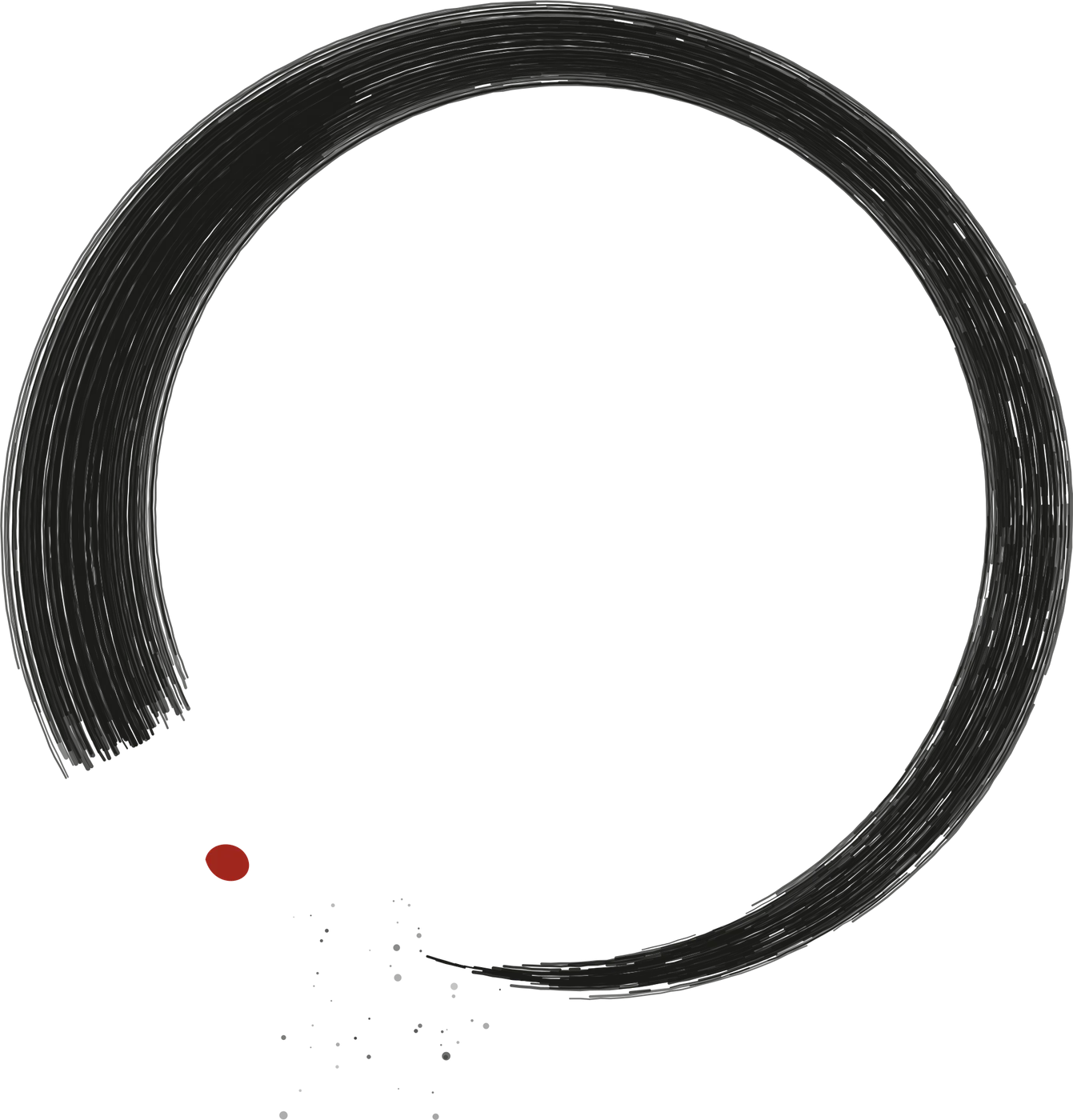
On the cover of this book there is a broken egg. And a brushstroke inspired by the Japanese circle, the ensō.
With a broken egg you have no idea whether it is a tragedy or something beautiful. Perhaps it broke. Perhaps a chick hatched from it. You cannot tell from the cover. You will have to look further, into reality. And that will be true more and more. It is terribly easy to write clever-sounding advice. Incredibly hard to behave the same way in reality.
An unfinished circle looks imperfect at first glance. But what is left unfinished leaves room. It is the empty space that lets imagination, chance and will complete what is missing. If we left no empty space, we would leave no room to live for the next generations either.
Some empty space will remain after us either way. If we hand on an unchangeable fortress, that empty space will in the end be outside it.
Writing this, I notice that all my images describe me sitting by a window. It is getting a little kitsch. I should probably go outside. In spring. The meadow will wake up whether I do anything for it or not.
Change is life. Handing on is life.
And so it begins. Again.