From Father to Nothing · the fifth letter
Structure Helps
Previously: The Fourth Generation
On my father's site I could always find somewhere to park back then. There was plenty of room. Offices, warehouses, a bicycle shop. Half empty. A kind of quiet.
The site belonged to a company that also sold bicycles there. Companies from the group sat in it for nothing, because in a way it belonged to them. A second company sold kitchenware, and its partners had guaranteed its operating loan with their own real estate. Another held nothing but real estate and would have made money. But its profit went on keeping its struggling sisters alive. And not much went back into the buildings.
A working kind of entrepreneurial socialism. To each company according to its needs, regardless of efficiency. Where nothing hurts, nothing has to change.
From the first moment it was clear to me that these things did not belong together. Before I say what we did about it, I will start with a simpler case. One building and several heirs.
When there are several heirs, co-ownership suggests itself. Co-ownership within a family is the worst invention there is, especially with real assets such as a house or a flat. The smaller the asset and the more co-owners, the bigger the problem. Who looks after the property and who profits from it drift apart. Unclear responsibility. Conflict and resentment.
When a building passes through one wave of inheritance, and then through another from those heirs, it is so fragmented that they cannot all manage it together. One person has to be chosen to be in charge. And money has to be collected for maintenance. For investment, heaven forbid. Who pays for an emergency repair, and how? Everyone has a different life and different problems. And everyone quickly gets used to a comfortable income from the rent. A relatively large asset very quickly turns into a sack of fleas.
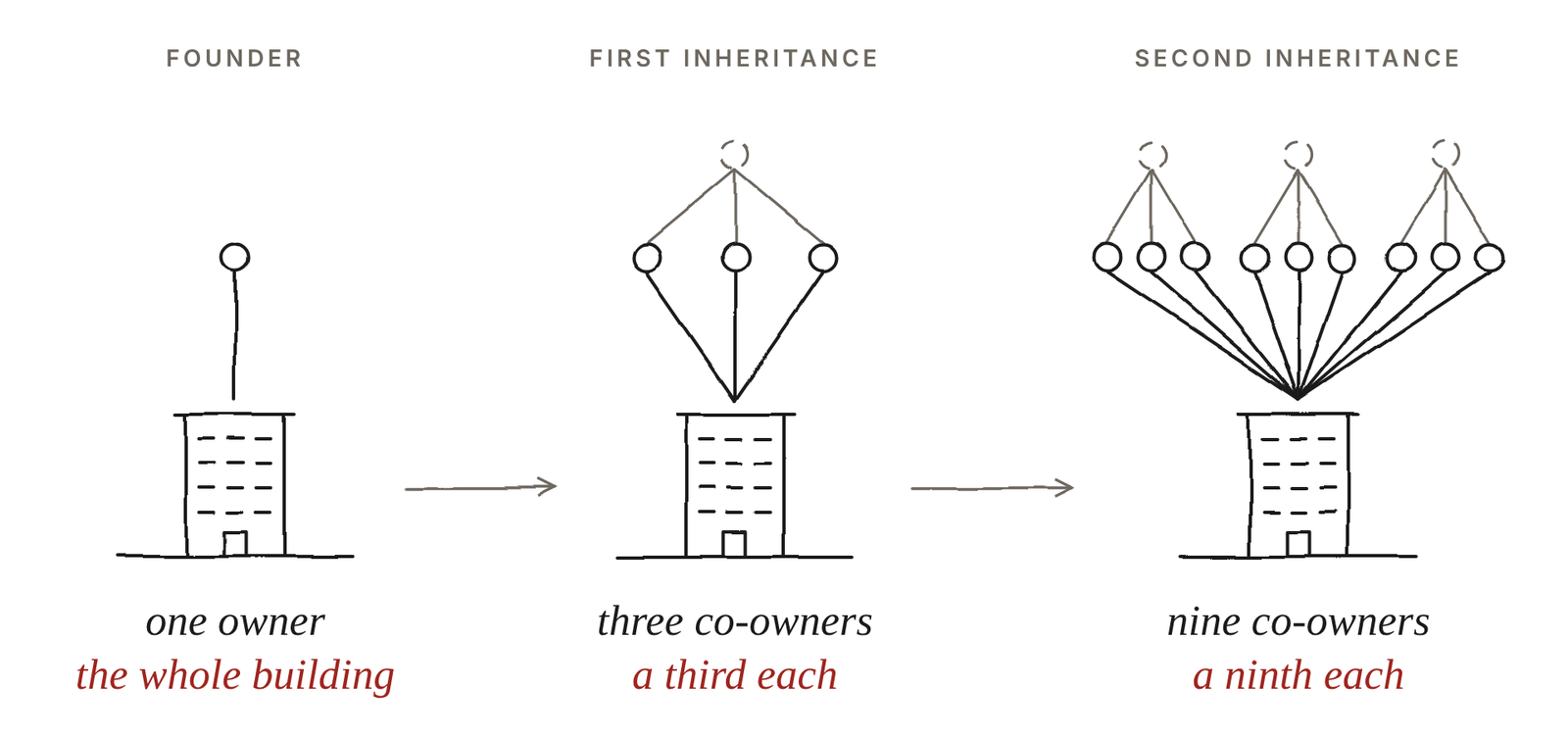
In the end everyone falls out. Then apathy sets in and nobody can be bothered. In the better case the building is sold and the money divided. In the worse case it decays, jointly. Or it wrecks the relationships altogether.
And yet wealth kept in one pile can carry more. It is easier to borrow against and easier to pay for something larger than when you are collecting the consent of ten, twenty, a hundred family members.
Wealth should not be fragmented. So the first step is always the same: put it into a company. Or a trust. That goes for a building and for a business alike. When someone runs a haulage business in his own name, every lorry on credit, and tomorrow his own bus runs him over in the yard, the bank will not be discussing further financing with his wife. Our advice is always: park it in a company, and only then deal with the rest. Let it be shares that are inherited and divided.
Whoever does the work gets more.
You set up a company. One person, elected by the partners, from the family or from outside, is responsible for looking after the property. And gets more out of that work than those who merely hold a share. What never works is the model where everyone is responsible for everything and everyone draws on everything in equal parts.
One person has to answer for the result, not a collective. In a collective there is always a good reason why the bad part is someone else's fault. The good part, everyone claims.
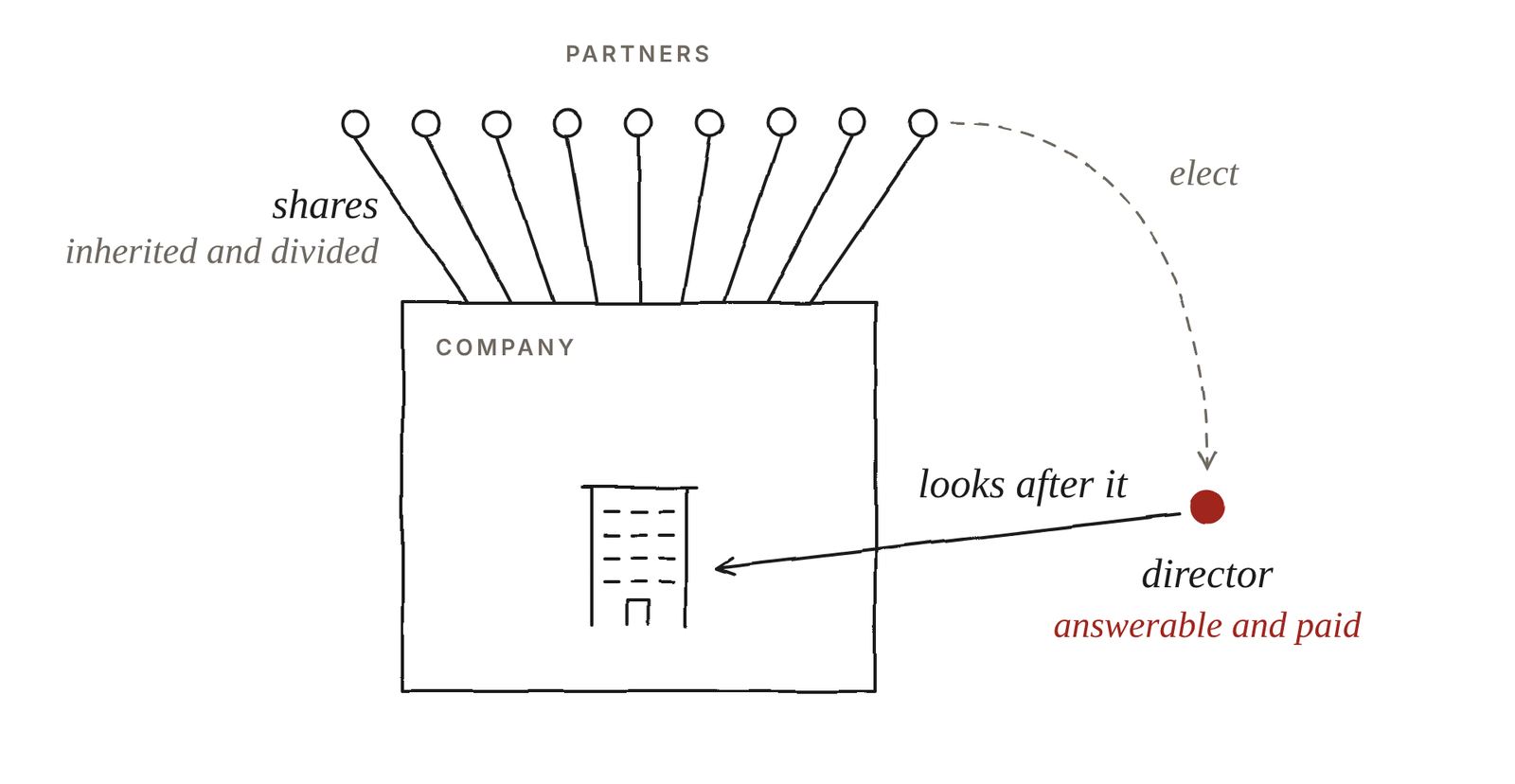
People find it fair to divide in equal parts. And in a family firm it is quietly expected that whoever owns, works. The law, meanwhile, expects no work from a partner at all. Three people inherit, a third each. That all three will work equally hard is very unlikely.
The one who does the looking after has to get more. Roughly what an outsider would get. Otherwise the volunteer becomes a slave to the family wealth, unable even to leave without hurting the common cause. And they will hold on until the end.
How to give them more is not obvious. Here in the Czech Republic, work is taxed far more heavily than a share of profit. So the active one is hit twice: they pull the load and pay more on top. The solution is to agree that whoever works gets a larger part of the profit than their share entitles them to. But everyone has to agree to that. And once the pitchforks are out, we will hardly agree that you should be paying me more.
So do it beforehand. While things are calm, write down four things. Who works and what they get for it. How a partner can leave. When and how much is paid out to those who do not work. In a limited liability company the majority decides whether profit is paid out, and a passive minority partner can hold a share that pays them nothing for years. And how many votes there are. My father had a quarter, the same as three others. Four partners with equal shares: that is a stalemate.
Who should run it? Not the one who earned it by happening to be born. The one best suited to it. And judging who would manage, inside the family or outside it, is terribly hard.
How to keep watch on him differs too. With an outside director we know how to be strict; with a relative, less so. A relative has a natural motivation to care for the family legacy. An outside director has a natural motivation to care for himself. To stay on, and to deliver only as much as he can get away with.
What is worth what? There is a market for real estate, and comparison is easy. The market for small companies that are not listed on an exchange is much harder.
With a building it is easy. Nobody walks off with a building, and a manager can be hired. With a firm that stands on one person, there is an enormous difference in value with him or without him. And when it does not earn enough to hire management, the partner is caught in the trap of his own assets. He does not want to leave on bad terms and has no way to leave on good ones. Ruin instead of joy.
Plenty of companies are losing money in economic terms even when the books show zero. The founder does not pay himself what he would have to pay a stranger. Count your own time and you will see. Even more so when the company sits in a building it owns and pays itself no rent.
This is how a brownfield is made. A factory has two parts, the operations and the real estate. The operations make money, until they do not. The building is fine, still maintained for now. And the owner, instead of closing the operations and letting the building, grits his teeth and subsidises. Real estate goes to ruin later than operations do. Either the operations drag it down with them, or it is sold off in the last gasp. Yet it is always more sensible to end a loss-making activity than to part with an asset that earns.
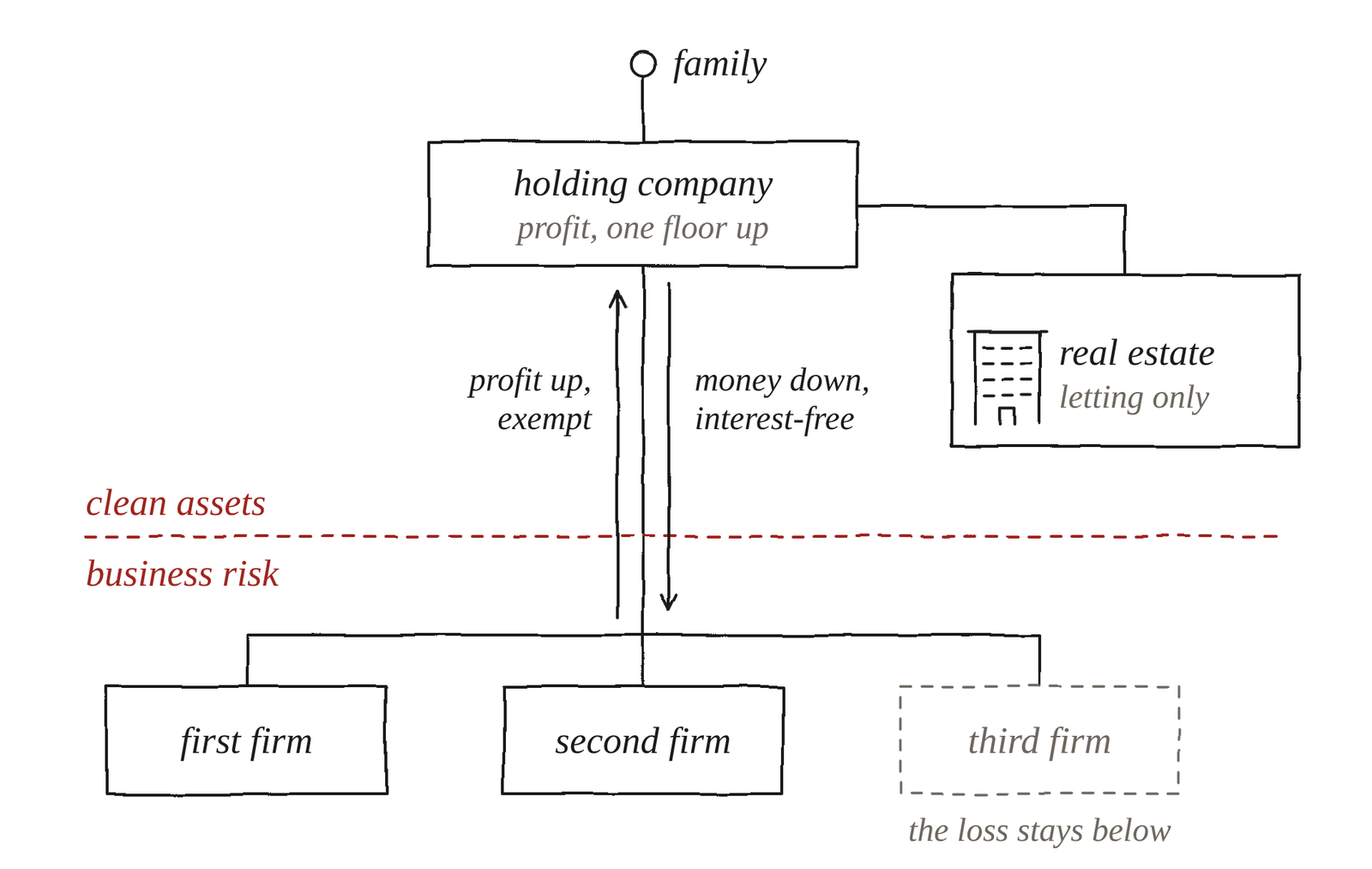
Hence a structure that separates clean assets from operations. Real estate goes into a company of its own. That company has a single job: to let. When letting makes no sense, to sell. A perfectly simple business model. The operating firms stand apart, each with its own risk.
Above them stands a holding company. It holds the shares in the subsidiary companies, and it is a different drawer. The profit of a subsidiary that is doing well, I pull one floor up. There it is parked. When the subsidiary stops doing well, and sooner or later it will, I have a choice. Either I support it from that drawer, or I do not. Without the drawer I have no such choice. The profit stayed downstairs, and I ride it all the way down to zero.
Taxes help. When I pay the profit out to myself as an individual, I pay tax on it. When the subsidiary company pays it to the parent, it is often exempt. Inside a group, money can often move without being taxed on the way. Check your local tax rules.
What is peculiar to the Czech Republic is that inheritance is not taxed here at all, and neither are gifts within the family. In much of Europe and the world, whole structures are built because of inheritance tax. Here the answer is simpler: just do it.
One more advantage, and in its way the most dangerous one. The parent can lend to the subsidiary, in the Czech Republic even without interest. Capital flows freely within the group. But this is exactly what my father did. A company deserves a loan only when it makes money, or when it can reasonably be expected to start. If it does not look that way, swallow the loss. And assets that have nothing to do with the operations do not stand as security for its loans. The hardest fight is keeping the promise I made to myself.
That this works on a large scale and over a long time, I know from Johannes Gullichsen of the Ahlström family. They have been in business for 175 years and number more than four hundred. In that time they sold the printing paper they had grown up on. They sold the engineering business, which then did well under its new owner. The family quarrelled over it. The holding company at the top remained. And the whole thing works.
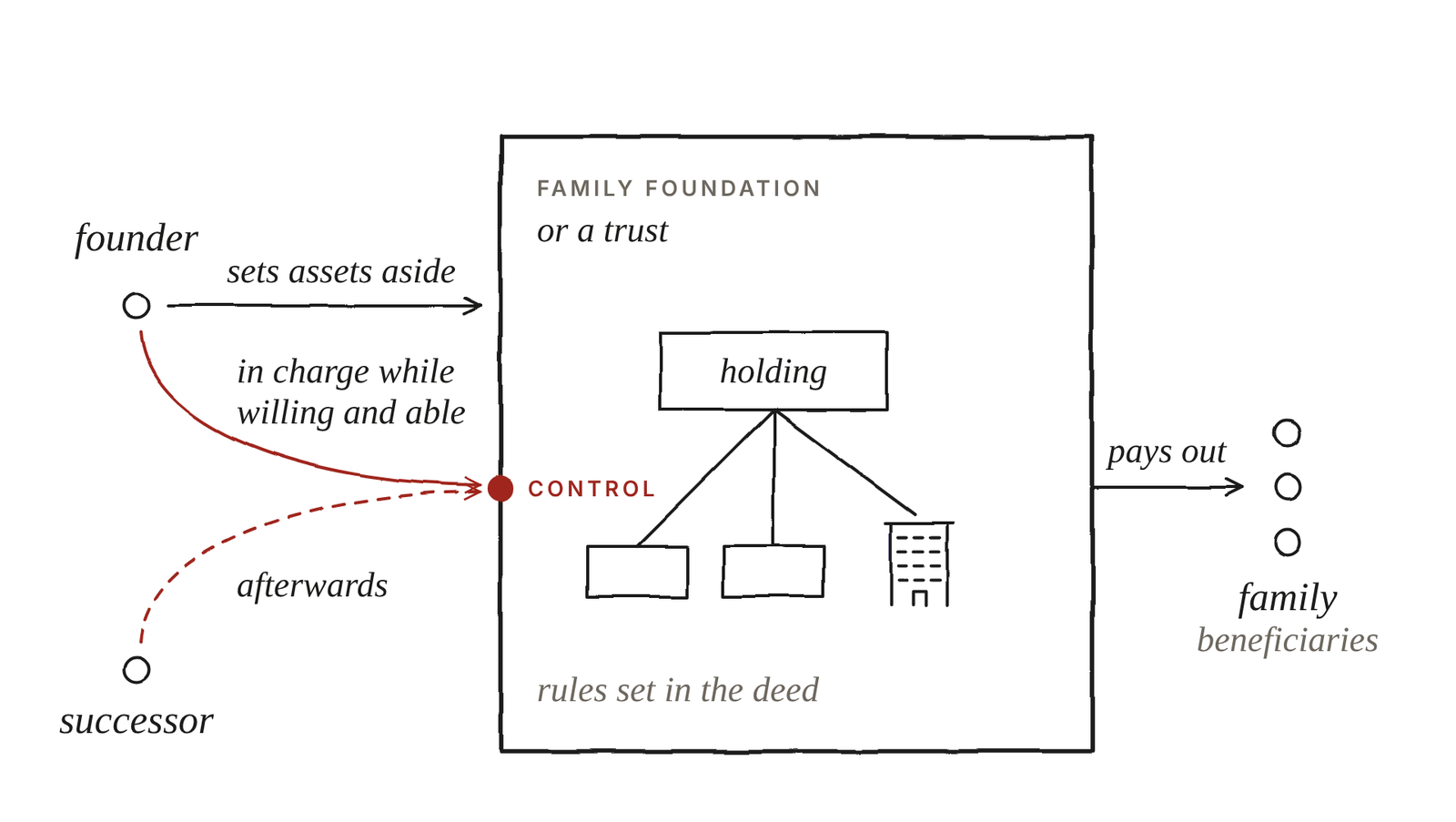
Above the holding company there may be a family foundation or a trust. It is one more separation of the assets, this time from the person of the founder.
It has nothing to do with the size of the wealth. It has to do with how the family is set up. A trust shields me from my own risks, whether I hit someone with my car or cause damage in business. But only if I set it up before the trouble comes.
And it lets me set out who is entitled to what, and on what conditions. Entrepreneurs tend to have more complicated families than one wife and two children. That they will all meet for the first time when the estate is being settled, and a rainbow will come out, is very unlikely. In a trust, one member of the family can run the assets and the others share the income. A child who would not hold on to the assets receives the income from them but cannot sell them. That is better than disinheriting. Disinheriting feels even worse than a prenup. It does not repair relationships. It destroys them.
Above all, it does not have to begin when I die. I can set up the trust now, hand the management to someone, and stay above it. For twenty years, if need be. As long as I am willing and able, I have control. I will see how he does. How it works when we pay ourselves money. I will replace him, or I will not. It would be good for the family to live through it not working, to say so, and to change it. While I am still around.
One problem. A trust does not end disputes, it moves them. In the United States, heirs often do not sue each other. They sue the trustee, for managing badly or for paying out too little.
And a will? Is that enough?
None of this can be solved by a will. A will divides shares. It does not separate real estate from operations, it does not say who runs things, or how much they get for it. Setting up a structure so that it starts working only at death is unrealistic. Leave it to the heirs to work out? At that moment they will have a million other things on their minds than working out how you would have worked it out.
A will: on balance, yes. But it is not enough. Handing over is a process, not a moment.
How did we do it ourselves?
My first steps led to where the loss-making operations were. As a family we did not want to go on running the bicycles or the kitchenware. It was not making money, and I saw no reason why that should turn around. The core of the business, to which my father gave his whole working life, we wrote off and left.
At the first meeting with the partners I said one thing, and I repeated it until the last. Operations will be separated from real estate. There will be no guarantees across companies. And what does not work will not be paid for by what does.
Stop the bleeding. Then clean up. Separate the clean assets from operations. Get rid of the cross-guarantees. Set the pay for the work.
It took time. Emotions, anger, sometimes tears. In the end we all agreed. From the company that held both real estate and operations we spun off the real estate and added it to the company that looks after real estate only. We cleaned up the loans, the guarantees, the security. Pay is no longer simply equal among the partners; it has a component for active work. We timed the spin-off for a moment when the loan was repaid and undrawn.
Since then, market rules have applied. The buildings make money. There is money to look after them. And we invest where it shows. We are renovating. New windows, a lift, a boiler room. Suddenly it can be done.
When I drive onto the site today, sometimes there is nowhere to park. So we have started to deal with entry restrictions and gates. A good problem to have. All it took was changing the structure.
As for you: consider whether it is time to leave some parts of your business. Do not leave it for someday. What awaits me now is what awaits you. To run the companies, to bring possible successors into them, to see who is good at what, and to think it through together with them. What goes into it is talked through together. But the children cannot take the first step. They cannot wrest the reins from the founder's hands. That step has to come from above. From you.
Michal Hanych