From Father to Nothing · chapter seven
People We Did Not Choose
Previously: The Worst Way
I was an introvert from childhood. One friend was enough. Two at most. I did not let many people close. My friend was usually whoever sat next to me in class. And more was not needed.
I had to learn it. Over time I got better at it. Let us be honest: what helped me most was alcohol and parties at university. And finding out that people are actually fine, and that everyone is simply afraid of being rejected or looking foolish.
In business I chose people who suited me. That is natural. And I think the founder’s main job is exactly that: choosing people. Or overseeing how they are chosen and how those who should leave are filtered out.
A founder chooses his people over decades. And filters them along the way. Shared experiences, failures and history bind them together. The successor gets the same people in a single day.
My father died. From that moment I had partners, employees and obligations I had not chosen. And they had not chosen me.
I walked into the companies unprepared. Even though we knew of each other. The last founding partner sat there, and the families of those who had already died. They had not chosen one another either. And I did not arrive as a lawyer. I arrived as the boy who used to drop in at his father’s office. They still remembered me as the little one. The boy in the picture on my father’s office wall. I might have been six in it.
You step onto a battlefield where someone before you has struggled for years. The disputes are older than you are. Years of living together have piled up grievances and misunderstandings. Nobody hands them to you in writing. Naturally; bad things are hard to talk about. Perhaps you learn them at a meeting. Perhaps never. Inside a silence that is not peace.
On top of that, rules that are written nowhere. We had an unwritten rule, for instance, that in a tied vote the chairman of the board decides. The chairman was my father. We had to make it clear that this is not how it works. We have equal votes. The law says one thing, custom another. And custom is often stronger.
Can the gap be closed? It can.
A newcomer has two routes to influence. To having a say in how things go. They can push with their shareholding. Rattle sabres and columns of lawyers. Or they can earn respect. Both work, but only with the second do people do what they promised when you are not looking. Shares can be inherited. Respect cannot.
A group lets a newcomer change things only once it has seen two things. That they respect how things are done there. And that they can do something. So my advice to successors is: build something that shows you can deliver. Ideally outside the firm you are to take over. And ideally a business of your own. To my mind nothing tests a successor’s abilities better. Even a failed business of your own teaches a great deal.
A Norwegian study of two and a half thousand family firms came to the same conclusion. Family successors who have never worked anywhere else run the firm worse than hired managers. Those who have worked outside run it just as well. And let us be honest, a hired outside director is no guarantee of a prosperous business either.
I had my own advisory firm behind me. I could read financial statements and I knew what it takes to get things voted through. About kitchenware and bicycles I knew nothing. But a business of your own is good preparation. An entrepreneur is used to an endless series of mishaps. And this was just one more.
Before I went to the partners, I went home. I told my mother and my brother where I wanted to take it. They said: you have our trust, you have a free hand. I took a power of attorney and had myself appointed administrator of the estate. So the partners knew they were not talking to three different heirs, but to one. And that we were not quarrelling among ourselves; as a family we spoke with one voice to the outside.
Then I counted the votes. With half I can block anything. With two thirds I can push through substantial changes. I picked out the partner who would be an ally. And still I told myself that a majority was not enough. I wanted everyone’s consent. I did not want a hostile takeover.
There was a reason. Whoever is outvoted does not cooperate. And a minority partner can sabotage the whole business. He has relationships with employees, suppliers and customers. The law is not much help there. Facts on the ground decide.
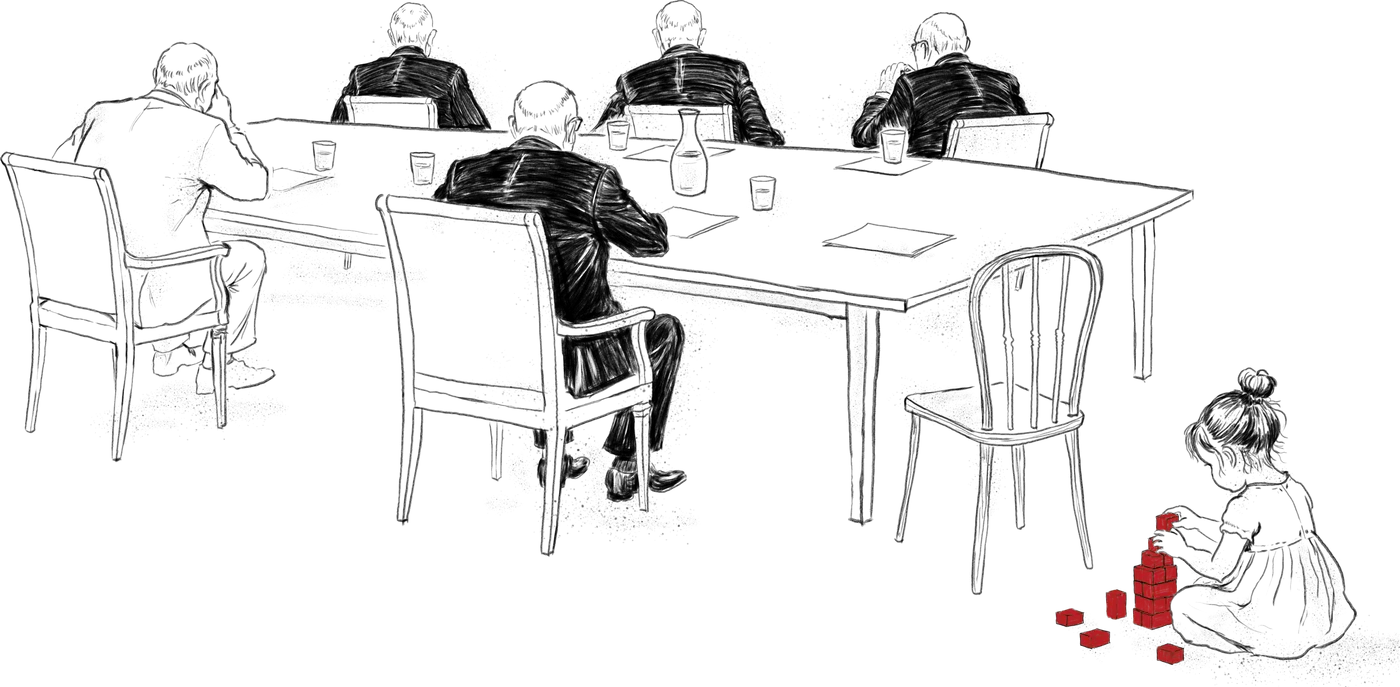
I arranged the first meeting with one of them. I brought my daughter along; she was four at the time. She played with Lego. I told him how I saw it. On the essentials we agreed.
The first general meeting was long. Very long. I had skipped breakfast. I simply had not had time. Morning turned into lunchtime, but without lunch. Then into afternoon. No result. We were sizing each other up. So we agreed to meet again. Another whole day.
At the meetings everything that had piled up over the years came out. One had sacrificed his whole life to the business. The other had sat there the whole time saying it was wrong, only nobody listened to him. The first is hurt: you could have said so all along. The second: I have been saying it all along, but you do not listen to me. Then it ends in shouting or tears. It is not pleasant. But it clears the air.
I try to be the calm one. On the outside I am. Inside, I always feel all sorts of things.
Listening pays off for another reason too. Someone who has been heard gives way more readily than someone you are trying to persuade.
You have to go into every negotiation with a clear idea of what you want. I had mine from the first minutes and held it to the end. What matters is how you press it. A factual argument works. Pressure does harm. And the sentence "I hold a share in this" does not work at all.
By everything I know about it, a newcomer should wait with changes until they have earned credit. I stated our direction at the first meeting. With respect, but unyielding from the first moment. I could probably afford that only because I had brought the credit with me from outside. Or because I am cheeky enough.
The rest of us came to it for free or by chance. Our risk profile is nothing like the founders’. We carried a different burden altogether. One is tempted to say a lighter one. Mainly a different one. How far should merit be respected? For the firm the choice is clear: whatever is more efficient is better. Emotions say something else. I gave my whole life to this and now you come along and tear it all up? A bull in a china shop.
One question helped me. How would I behave if it had not been my father who died, but the other founding partner? Where would I push things if it were the other way round? The respect for what they built, I owe them in advance. Agreement with how they run it today, I do not.
With employees it is harder than with partners. They have been there a long time. Their relationship is with my father, not with me. That they would turn to the heir as a saviour is not going to happen. They have the inertia of doing things the way they have always done them. And in their eyes the predecessor grows with every month. You cannot compete with a dead man, and there is no point trying.
How far should a business be a sheltered workshop, and how far a business? I have also heard the expression "telephone box". Some people stay on like those boxes that are no longer really needed today. I make cynical jokes about it, but parting with someone just before retirement is hard. They will struggle to find other work. We feel responsible for them.
The question is not whether they respect me. The question is whether we are playing for the same side. Where we are not, it is wiser to part than to stay together in something that does not work. And in time the successor should get the room to choose people as if they had been choosing them all along.
My father’s partners taught me a lesson in humility. I still rather lack it. But I hope I am improving.
In the end we all agreed. With some of them I am closer today, with others further apart. That is how it was back then too.
In a family firm you never choose your co-owners. Siblings, cousins, the married-in.
And it can be learned. I am not the only one saying so. Charisma is a set of techniques and can be trained. People who want to be more open and take small concrete steps towards it move measurably within a few months. With a vague resolution they do not.
For successors:
Bring something of your own. Ideally built outside the family firm.
First make sure the family speaks with one voice.
Map the battlefield before you do anything on it. Who sides with whom, what was promised, what holds only by custom.
Listen. Including what nobody has said aloud for years.
Give respect in advance. Not agreement.
Argue the matter, not your shareholding.
Do not compete with your predecessor.
A founder chooses his people. A successor has to win them over. It can be done. Even if one friend was enough for you as a child. Two at most.